Tools & Trends
Apr 30, 2026
Best Accounting Tools for Creators
This article breaks down the best accounting tools creators should know, where traditional accounting software helps, where it falls short, and why creator-native financial systems like Endow are becoming essential.
For most creators, accounting becomes important the moment growth starts to feel confusing.
At first, money feels simple.
A few payments here.
A client transfer there.
A digital product sale every now and then.
Tracking it feels manageable.
Then the business grows.
Revenue starts coming from multiple places.
A course launch generates income.
A brand collaboration lands.
Payment links start converting.
Audience support comes in.
A collaborative bundle launches.
A freelance project gets paid in stages.
Suddenly, the question is no longer:
“Did I make money?”
It becomes:
“Where exactly is my money coming from, what is actually profitable, and how do I track all of this properly?”
This is where creators start looking for accounting tools.
And that search usually leads to the same names.
QuickBooks.
Xero.
FreshBooks.
Wave.
These are all solid tools.
They work well for traditional businesses.
But creator businesses are not traditional businesses.
And this is the problem most creators eventually run into.
The best accounting tool for a creator is not simply the one that tracks transactions.
It is the one that reflects how creator money actually moves.
Because creator income behaves differently.
It is fragmented.
Collaborative.
Platform-driven.
Product-based.
Often irregular.
This article breaks down the best accounting tools creators should know, where traditional accounting software helps, where it falls short, and why creator-native financial systems like Endow are becoming essential.

Why Creators Need Accounting Tools Earlier Than They Think
A common mistake creators make is assuming accounting is something they can deal with later.
Later when revenue is bigger.
Later when they register a business.
Later when things become more serious.
But financial systems are not something you add after growth.
They are what make growth manageable.
Without them, creator businesses become financially reactive.
And reactive businesses rarely scale well.
What Happens Without Proper Accounting Systems
When creators rely on memory, scattered alerts, and disconnected payment records, several problems appear.
Revenue Feels Bigger Than It Is
A creator sees money entering multiple accounts and assumes growth is happening.
But without tracking:
Expenses are unclear
Profit margins are invisible
Revenue trends are misunderstood
This creates false confidence.
Financial Decisions Become Emotional
Without clear numbers, decisions are driven by feeling.
Questions like:
“Can I afford this?”
“Should I hire?”
“Is this month strong?”
Become guesswork.
Collaboration Becomes Difficult to Manage
Modern creator businesses are increasingly collaborative.
Editors.
Designers.
Co-creators.
Course partners.
Once money is shared, poor tracking creates friction quickly.
Tax Season Becomes Stressful
Missing records.
Unclear revenue history.
Poor documentation.
This creates unnecessary pressure.
What Makes an Accounting Tool Useful for Creators
Creators do not necessarily need enterprise accounting software.
They need visibility.
The right tool should help answer:
How much did I earn?
Where did it come from?
What did I spend?
What is growing?
What is underperforming?
What is actually profitable?
For creators specifically, a strong financial tool should support:
Multi-income stream tracking
Expense monitoring
Payment collection
Revenue visibility
Collaboration tracking
Financial clarity
The issue is that many traditional tools only solve part of this.

Traditional Accounting Tools Creators Should Know
Let’s start with the major players.
These tools are valuable.
But understanding their limitations matters.
1. QuickBooks
Best for Formal Bookkeeping
QuickBooks is one of the most established accounting tools globally.
It offers:
Expense categorization
Reporting
Invoicing
Tax preparation
Financial statements
For creators operating at a larger scale, it can provide strong financial structure.
Why Creators Use It
QuickBooks works well when:
Revenue is stable
Financial complexity is high
Compliance reporting matters
It helps formalize business operations.
Where It Falls Short
QuickBooks tracks transactions well.
But creator businesses are more than transactions.
It does not naturally reflect:
Creator-specific revenue streams
Digital product ecosystems
Revenue splitting workflows
Audience monetization behavior
It organizes numbers.
It does not understand creator context.
2. Xero
Best for Growing Creator Businesses
Xero offers a cleaner, more intuitive accounting experience.
It is strong for creators who want:
Automated reconciliation
Reporting
Multi-currency support
This makes it useful for creators earning internationally.
Strengths
Its interface is easier to navigate than many legacy accounting systems.
This lowers operational friction.
Limitation
Like most traditional accounting tools, it is still built around standard business finance structures.
It tracks what happened.
Not necessarily why it happened within creator workflows.
3. FreshBooks
Best for Service-Based Creators
FreshBooks is excellent for:
Writers
Consultants
Designers
Strategists
Its invoicing-first approach works well for service delivery.
Why It Works
It simplifies:
Sending invoices
Tracking payments
Managing clients
For creators who primarily sell services, this can be enough.
The Gap
As soon as creator income expands into:
Courses
Digital products
Revenue splits
Payment link sales
Its usefulness becomes narrower.
4. Wave
Best Free Option
Wave is often recommended for creators starting out.
Its biggest advantage is accessibility.
It allows creators to begin organizing finances without upfront software costs.
Good For
Early-stage creators needing:
Basic bookkeeping
Expense tracking
Simple invoicing
The Limitation
As income complexity grows, Wave becomes restrictive.
It helps document money.
It does not help creators structure money.

Why Traditional Accounting Tools Are Not Enough
Here is the real issue.
Traditional accounting tools were built for businesses with predictable structures.
Most assume revenue behaves like this:
Invoice sent
Payment received
Expense logged
Books updated
Creator businesses are different.
Money often moves through:
Audience support
Course sales
Instant payment links
Collaborative bundles
Revenue splits
Cross-platform monetization
Recurring digital products
This complexity creates blind spots.
And blind spots create poor decisions.
The Real Problem: Accounting Tools Track Transactions, Not Creator Ecosystems
Creators do not just need bookkeeping.
They need business intelligence.
They need to understand:
Which products perform best
Which payment channels convert
Which collaborations are profitable
Which revenue streams are scalable
Traditional accounting software rarely answers these questions well.
This is where creators start outgrowing generic tools.
What Creators Actually Need
The ideal financial system for creators combines:
Revenue Collection
Getting paid simply
Income Visibility
Seeing all revenue streams clearly
Collaboration Infrastructure
Handling shared earnings properly
Financial Intelligence
Understanding business performance
This is the gap most accounting tools leave open.
And it is why creator-native financial systems are emerging.
Why Endow Belongs on This List
If this article were just another roundup of bookkeeping tools, it would miss the point.
Because Endow is not trying to be another generic accounting platform.
It is built around creator financial behavior.
That distinction matters.
Endow Tracks Creator Revenue the Way Creators Actually Earn
Traditional accounting tools often force creators to adapt to business models they were not built for.
Endow works in the opposite direction.
It is designed around creator income structures.
This includes:
Payment links
Course sales
Digital product revenue
Collaborative earnings
Multi-stream income visibility
Instead of simply recording transactions, Endow helps creators understand the financial mechanics of their business.
Built-In Payment Infrastructure
Most accounting tools start after money arrives.
Endow starts at the point of monetization.
Creators can:
Generate payment links
Sell products
Launch courses
Receive payments directly
This removes fragmentation.
Revenue Splitting for Collaboration
This is one of the biggest differences.
Creator businesses are increasingly collaborative.
Yet most accounting tools treat collaboration as an afterthought.
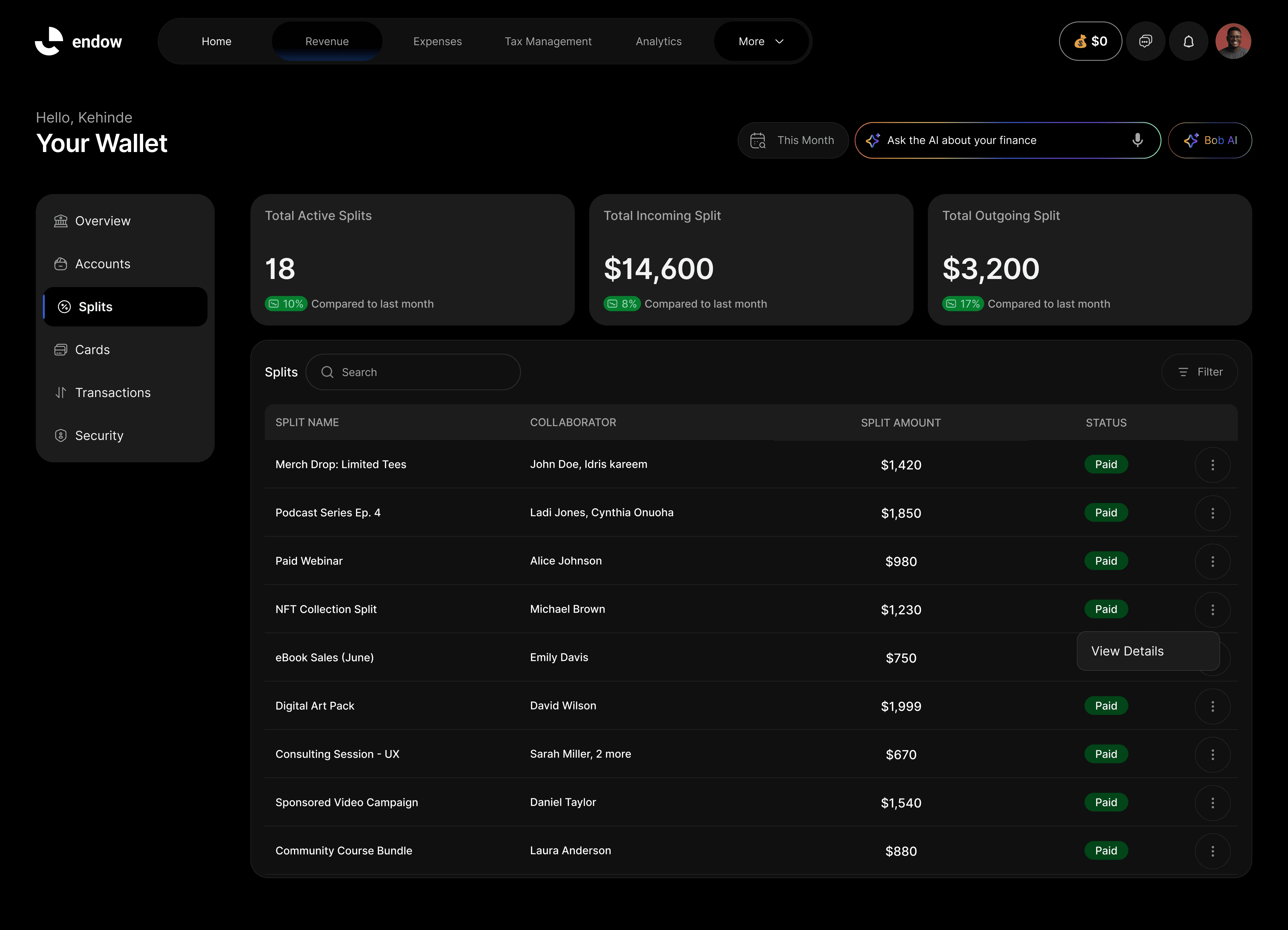
Endow supports structured revenue splitting.
This means creators can:
Define earning structures clearly
Manage collaborative income transparently
Reduce payment confusion
This is a major advantage.
Financial Visibility Across Everything
Instead of scattered tools for:
Selling
Receiving
Tracking
Managing
Endow connects these functions.
This gives creators something traditional tools often cannot:
A unified financial view of their business.
So What Is the Best Accounting Tool for Creators?
The answer depends on what you need.
If You Need Formal Bookkeeping
QuickBooks or Xero are strong options.
Especially for tax reporting and traditional accounting structure.
If You Are Primarily Service-Based
FreshBooks works well.
If You Are Just Starting
Wave can help build early discipline.
If You Need Creator-Native Financial Infrastructure
This is where Endow stands out.
Because creators need more than accounting.
They need systems built around:
How they earn
How they collaborate
How they scale
And how their money actually moves
Final Thought
The best accounting tool for creators is not simply the most powerful software.
It is the one that gives the clearest understanding of your business.
Accounting is not about spreadsheets.
It is about clarity.
And clarity changes everything.
It changes how you price.
How you hire.
How you plan.
How confidently you grow.
Traditional accounting tools can help organize your books.
But creators building modern digital businesses increasingly need something deeper.
They need financial systems designed for the realities of creator income.
That is where the future is heading.
And that is exactly where Endow is positioned.
Stop forcing creator income into systems built for traditional businesses.
Track your revenue, manage collaborations, and build financial clarity with tools designed for how creators actually earn.
👉 Start building smarter financial systems with Endow
Related Content