Money Made Simple
Mar 10, 2026
How to Prepare Your Records for Tax Season (A Creator’s Practical Guide)
Preparing for tax season as a creator does not have to be stressful. Learn how to organize your income, track expenses, and build a system that keeps your records clean all year.
Tax season does not start when the deadline is announced.
It starts months before, quietly, in the way you track your money.
For most creators, this is where the real problem begins. Not with taxes themselves, but with missing structure.
Payments are scattered across platforms
Expenses are mixed with personal spending
Income is remembered, not recorded
Deadlines arrive before clarity does
By the time tax season comes around, it feels overwhelming.
This guide is designed to change that.
Not with theory, but with a clear system for preparing your records properly, so tax season becomes a process, not a panic.
Why Tax Preparation Is Hard for Creators
Traditional employees have it easier.
Taxes are deducted automatically. Records are structured. Income is predictable.
Creators operate differently.
You might earn from:
Brand deals
Digital products
Freelance work
Platform payouts
Tips or donations
Each income stream comes with:
Different payment timelines
Different currencies
Different documentation
And in Nigeria, oversight comes from bodies like the Federal Inland Revenue Service and state-level agencies such as the Lagos State Internal Revenue Service.
If your records are not organized, you are exposed.
Not just to penalties, but to poor financial decisions.
What “Tax Records” Actually Mean for Creators
Most creators think tax records mean:
👉 “How much I earned”
That is incomplete.
Your tax records should show:
1. Total Income
Every naira or dollar earned across all sources.
2. Business Expenses
What it cost you to run your creator business.
3. Net Profit
What is left after expenses, this is what is typically taxed.
4. Supporting Proof
Invoices, receipts, transaction logs.
Without these four, your records are not complete.

Step 1: Separate Business and Personal Money
This is the foundation.
If you skip this, everything else becomes messy.
Creators often:
Receive payments into personal accounts
Spend business money casually
Mix everything together
The result:
👉 You cannot tell what belongs to your business
What to Do Instead
Create a clear structure:
One account for income and business transactions
One account for personal spending
When money comes in, it stays in your business flow first.
Only what you intentionally move becomes personal.
Why This Matters
You reduce confusion
You track expenses properly
You avoid underreporting or overreporting
This single step solves most tax problems before they start.
Step 2: Track Every Income Source
Tax preparation is not about totals.
It is about traceability.
You should be able to answer:
Where did this money come from?
When did it come in?
What type of income is it?
Common Creator Income Categories
Brand partnerships
Product sales
Course revenue
Freelance services
Affiliate earnings
Platform payouts
Each one should be tracked separately.
The Mistake to Avoid
Many creators only check their bank balance.
That is not tracking.
That is reacting.
Tracking means:
👉 You understand your income before tax season begins
Step 3: Record All Business Expenses Properly
Expenses reduce your taxable income.
But only if you track them correctly.
Common Deductible Expenses for Creators
Internet and data
Equipment (camera, laptop, lighting)
Software subscriptions
Transportation for work
Rent portion used for content creation
Contractor payments (editors, designers)
What Most Creators Get Wrong
They either:
Do not track expenses at all
Or track them inconsistently
And then during tax season:
👉 They guess
Guessing costs money.
What You Should Do
Every expense should have:
Amount
Date
Purpose
Category
And where possible:
👉 A receipt or proof

Step 4: Keep Proof of Transactions
This is where many creators fail silently.
Tracking numbers is not enough.
You need proof.
What Counts as Proof
Invoices sent to clients
Payment confirmations
Receipts for purchases
Bank transaction logs
Why This Matters
If you are ever reviewed:
👉 Numbers without proof are weak
Documentation protects you.
Step 5: Understand Your Taxable Income
Not all money you receive is profit.
Basic Formula
Total Income – Expenses = Taxable Income
Example
You earned: ₦5,000,000
You spent: ₦2,000,000
Your taxable income is:
👉 ₦3,000,000
Why This Matters
Without proper records:
You may overpay tax
Or underpay and face penalties
Clarity saves money.
Step 6: Prepare for Irregular Income
Creators do not earn consistently.
Some months are strong.
Some are quiet.
The Problem
If you only prepare during high-income months:
You may overspend
You may under-save for taxes
The Solution
Set aside a percentage of every income.
A common approach:
👉 20–30% reserved for taxes
This ensures you are never caught off guard.
Step 7: Organize Your Records Monthly, Not Yearly
The biggest mistake creators make:
👉 Waiting until tax season to organize everything
What You Should Do Instead
At the end of every month:
Review income
Categorize expenses
Save receipts
Check totals
Why This Works
You reduce stress
You catch errors early
You stay prepared
Tax season becomes a summary, not a scramble.
Step 8: Use a System, Not Just Memory
Manual tracking works until it doesn’t.
As your income grows, complexity increases.
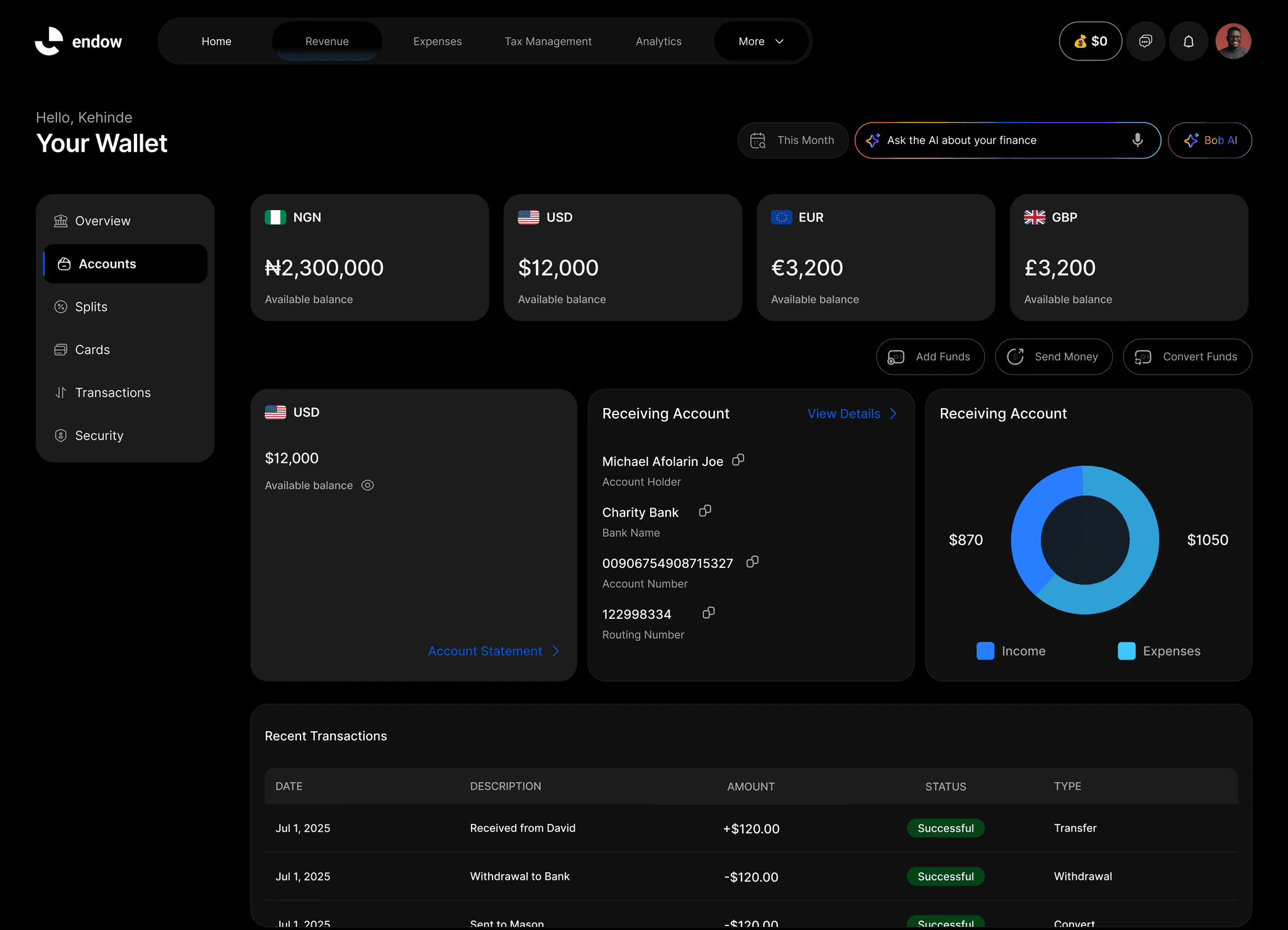
What a Good System Should Do
Centralize income
Categorize transactions
Track multiple revenue streams
Separate business and personal flows
Provide visibility
Where Endow Fits In
Endow is built for this exact problem.
Instead of managing:
Different platforms
Multiple accounts
Scattered records
You get:
👉 One place to see and organize everything
What Endow Helps You Do
Track income across sources
Manage payments and invoices
Organize transactions automatically
Understand your financial position in real time
Tax preparation becomes simpler because your records already exist.
Step 9: Prepare Your Final Tax Summary
When tax season arrives, your goal is simple:
👉 Turn your records into a clear summary
What Your Summary Should Include
Total income (by category)
Total expenses (by category)
Net profit
Supporting documents
If You Work With an Accountant
This is what they need.
The cleaner your records:
👉 The faster and more accurate your filing
Step 10: Avoid Last-Minute Panic
Tax stress is usually self-created.
Not because taxes are complicated.
But because preparation was delayed.
Signs You Are Not Prepared
You cannot explain your income clearly
You are searching for old transactions
You are guessing expenses
You feel rushed
What Prepared Looks Like
Your records are updated monthly
Your income is categorized
Your expenses are documented
Your totals are clear
At that point:
👉 Tax season is just submission
The Bigger Picture: Tax Preparation Is Financial Clarity
This is not just about compliance.
It is about understanding your business.
When your records are clean:
You know how much you actually earn
You know what you spend
You make better decisions
Tax preparation becomes a byproduct of good financial management.
Conclusion
Creators who struggle during tax season are not less capable.
They are just less structured.
When you:
Separate your money
Track your income
Record your expenses
Keep proof
Organize consistently
You remove the chaos.
And once the chaos is gone:
👉 Taxes become manageable
Related Content