Learn & Grow
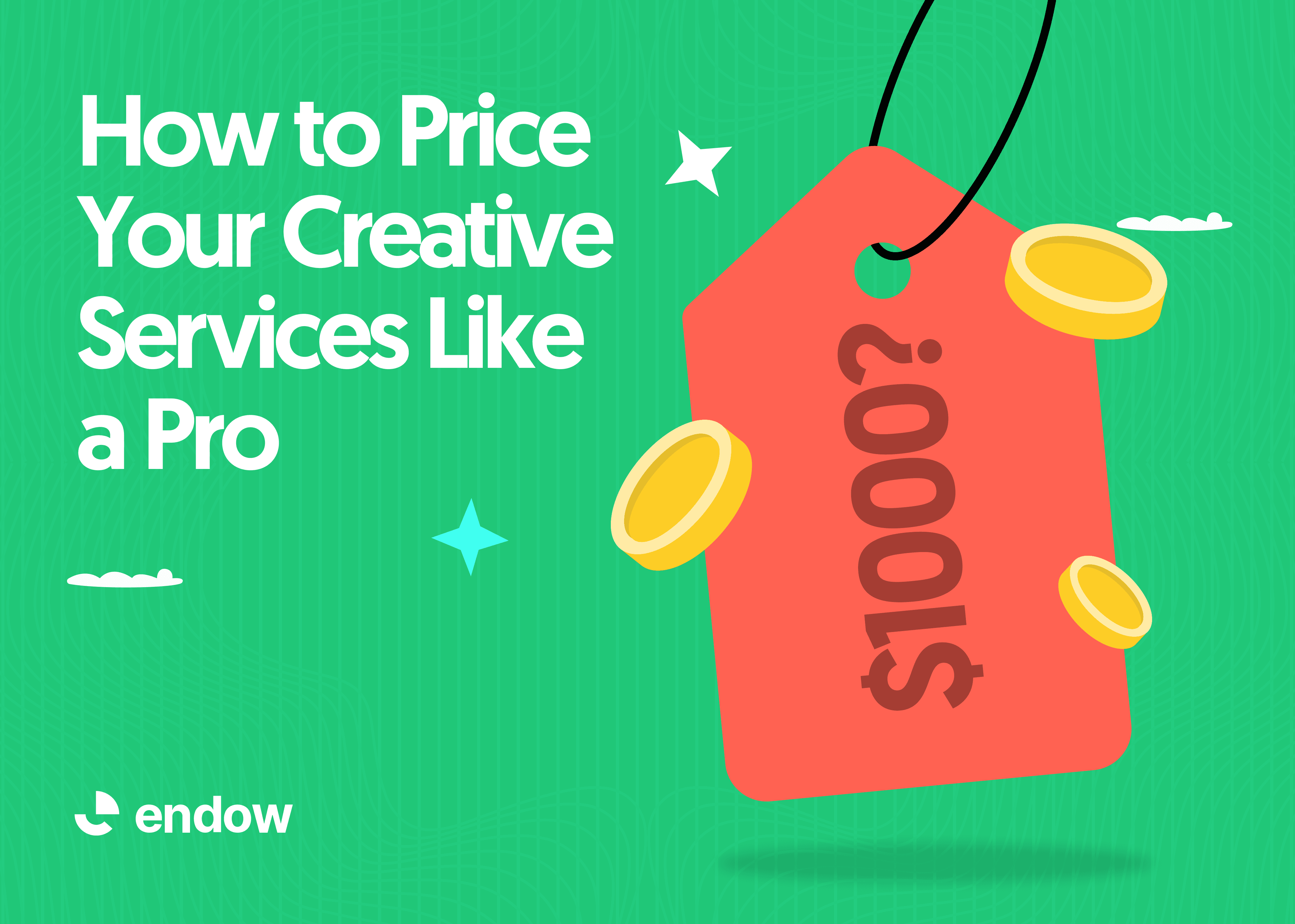
How to Price Your Creative Services Like a Pro
Stop undercharging for your creative work. Learn how to price your creative services like a pro—set your rates, communicate your value, and grow your income confidently with Endow.
Let’s be honest:
For many creators, pricing is the hardest part of the business.
You can spend hours designing, filming, editing, or writing — but when it’s time to quote your price, the confidence suddenly disappears.
You ask yourself:
“What’s the right rate for my kind of work?”
“What if I charge too much and lose the client?”
“What if I charge too little and regret it later?”
Sound familiar? You’re not alone.
Across Nigeria and Africa’s growing creator economy, thousands of freelancers and influencers are still figuring out how to price their creative services sustainably — especially in a market where clients sometimes expect “exposure” instead of payment.
But here’s the truth:
Pricing isn’t about guessing — it’s about knowing your value and structuring it strategically.
This guide will teach you exactly how to do that — step by step.
You’ll learn how to price your creative services like a pro, avoid burnout, and build a system that ensures your creativity pays — literally.
1. Understand What You’re Really Selling
Before we dive into numbers, you need to understand what you’re actually charging for.
You’re not just selling:
A logo
A video
A campaign shoot
A social media strategy
You’re selling expertise, time, experience, and results.
When a brand pays you, they’re paying for:
✅ The years you spent learning your craft
✅ The equipment you’ve invested in
✅ The creative problem you’re solving
✅ The measurable impact on their audience or sales
Once you internalize that, you stop thinking like a “service provider” and start thinking like a creative business.
2. Know Your Costs (So You Don’t Work at a Loss)
One major reason creators undercharge is they don’t calculate their actual costs.
Here’s what you should include:
Cost Category | Examples |
|---|---|
Direct Costs | Equipment, props, software subscriptions, location rentals |
Indirect Costs | Internet, electricity, data, taxes, platform fees |
Labor Costs | Your time (per hour), assistants, collaborators |
Add up your monthly expenses and divide by the number of projects you can handle per month. That gives you your break-even point.
💡 Example:
If your total monthly costs are ₦600,000 and you complete 6 projects per month, your minimum per-project charge should be ₦100,000 — before profit.
Anything less means you’re working at a loss.
3. Research the Market (But Don’t Copy It Blindly)
Knowing what others charge is useful, but don’t price yourself solely based on “industry average.”
Instead, benchmark your prices with context:
Service | Entry-Level Range (₦) | Mid-Level Range (₦) | Pro-Level Range (₦) |
|---|---|---|---|
Logo Design | 30,000–70,000 | 80,000–200,000 | 250,000+ |
Video Editing (per min) | 10,000–25,000 | 30,000–60,000 | 70,000+ |
Brand Strategy | 100,000–300,000 | 350,000–700,000 | 800,000+ |
Social Media Campaign | 150,000–400,000 | 500,000–1.2M | 1.5M+ |
Use this as reference — then adjust based on your experience, client type, and project scope.
4. Price Based on Value, Not Just Time
Hourly pricing can limit your earning potential.
Instead of thinking “how long will this take me?” — ask:
“How much value does this bring to the client?”
For example:
If your design helps a brand land ₦5 million in new sales, charging ₦500,000 isn’t unreasonable.
If your video helps an artist gain 50,000 new followers, that’s measurable brand value.
Formula for Value-Based Pricing:
Price = (Perceived Value × Impact) ÷ Time Invested
It’s not about being expensive — it’s about aligning price with impact.
5. Choose the Right Pricing Model for Your Work
Not all creative projects should be priced the same way.
Here are the four main models — and when to use each:
Model | Best For | Pros | Cons |
|---|---|---|---|
Hourly Rate | Consulting, editing, short tasks | Fair for time-based work | Limits income if you’re efficient |
Project-Based | Design, campaigns, deliverables | Clear pricing; easier for clients | Risk of underestimating time |
Retainer | Ongoing content, brand management | Stable income stream | Requires consistent delivery |
Value-Based | Strategy, branding, consulting | Rewards high-impact work | Harder to calculate early on |
💡 Pro tip: Mix models strategically.
Use project-based pricing for new clients, then transition them to a retainer once trust is built.
6. Communicate Your Value Clearly
Creators often lose negotiations not because their rates are high — but because they fail to explain why.
When presenting your price, always include:
Deliverables: What the client gets (with clear descriptions).
Timeline: How long it takes and your process.
Outcome: What the result or impact will be.
Here’s how you can frame your proposal:
“This ₦400,000 campaign includes 3 edited videos, 10 stills, 1 social media strategy, and a content calendar. You’ll receive everything optimized for Instagram and TikTok, with delivery in 14 days.”
That’s not a “price” — that’s a professional offer.
7. Use Anchoring to Your Advantage
Anchoring is a pricing psychology trick that works — every time.
When you show clients multiple pricing tiers, they’re more likely to choose the middle one (not the cheapest).
Example:
Package | Description | Price (₦) |
|---|---|---|
Basic | 1 video edit + 3 social graphics | 150,000 |
Standard | 3 videos + 10 graphics + content calendar | 400,000 |
Premium | Everything in Standard + monthly insights + post scheduling | 800,000 |
Most clients will pick “Standard” — which is exactly where your sweet spot lies.
8. Account for Taxes, Platform Fees, and Exchange Rates
If you earn from multiple platforms or clients abroad, your income isn’t 100% take-home.
You must account for:
Platform fees (e.g., Gumroad 10%, Fiverr 20%)
Currency conversion differences (USD to NGN)
Taxes (especially under Nigeria’s new digital tax system starting 2026)
💡 Tip: Always add a 10–15% buffer to your price to cover these hidden costs.
9. Track Your Income — Don’t Guess It
Once you’ve set your rates, tracking what comes in (and when) becomes critical.
Too many creators lose money simply because they can’t see where it’s going.
You should know:
Which services earn you the most
Which months are busiest
Which clients pay fastest
Manually, that’s exhausting — but tools like Endow simplify it.
Endow connects all your income sources — YouTube, Selar, Shopify, Gumroad, Patreon, and more — into one dashboard.
It tracks your real-time earnings, automates currency conversions, and even forecasts your income trends so you can plan your next rate increase confidently.
10. Review and Adjust Regularly
Pricing isn’t static — it evolves with your skill and demand.
A simple rule:
Review your rates every 6–12 months or after every major client success.
Ask yourself:
Have my skills improved?
Has demand increased?
Have my costs gone up?
Have I added more value or speed?
If yes, it’s time for a raise.
Even a 10–15% annual increase compounds significantly over time — and signals professionalism to your clients.
11. Handle Negotiations Professionally (Without Undervaluing Yourself)
When a client says, “That’s too expensive,” don’t panic — respond with clarity, not emotion.
Try this:
“I completely understand budgets are tight. Here’s how we can adjust scope instead of lowering quality.”
Then remove or reduce deliverables, not your worth.
For example, if the original package had 5 videos, cut it to 3.
That way, your rate stays consistent — and the client still feels accommodated.
Confidence builds trust. Clients pay more when they sense professionalism and stability.
12. Build Passive Income Into Your Pricing Strategy
Pricing smartly also means thinking long-term.
You can only sell your time once — but you can sell your ideas infinitely.
That’s where digital products come in:
Templates and presets
E-books or mini-courses
Membership communities
Stock photography or music loops
Platforms like Selar, Gumroad, or Shopify make it easy to sell these.
And with Endow, you can track all your earnings across them, in one place.
This way, your income doesn’t crash when client work slows down.
13. Build a Reputation That Commands Premium Pricing
Ultimately, pricing confidence comes from proof.
Build that by:
Showcasing strong case studies
Posting client testimonials
Publishing behind-the-scenes or process videos
Demonstrating measurable results (“helped brand X increase engagement by 40%”)
When people see evidence, they stop asking for discounts.
14. Learn When to Say No
Not every client fits your value system.
If a client constantly delays payment, questions your worth, or demands “free trials,” politely decline.
Protect your creative energy — that’s your real currency.
When you set boundaries, the right clients will find you.
Conclusion: Price Like a Professional, Get Paid Like One
Pricing your creative services doesn’t have to feel like a guessing game.
When you know your costs, understand your value, and communicate clearly, you shift from hustler to professional.
The goal isn’t just to make money — it’s to build a sustainable creator business that funds your life, your growth, and your creativity.
And that’s where Endow comes in.
With Endow, creators finally get a financial system designed for the creative economy — not corporate accountants.
You can track your income across platforms, forecast trends, and manage collaborations seamlessly — all in one intuitive dashboard.
💡 Because when your creativity and finances align, your business becomes unstoppable.
👉 Start managing your creator income the smart way — join Endow today.
Related Content