Create Smarter
May 14, 2026
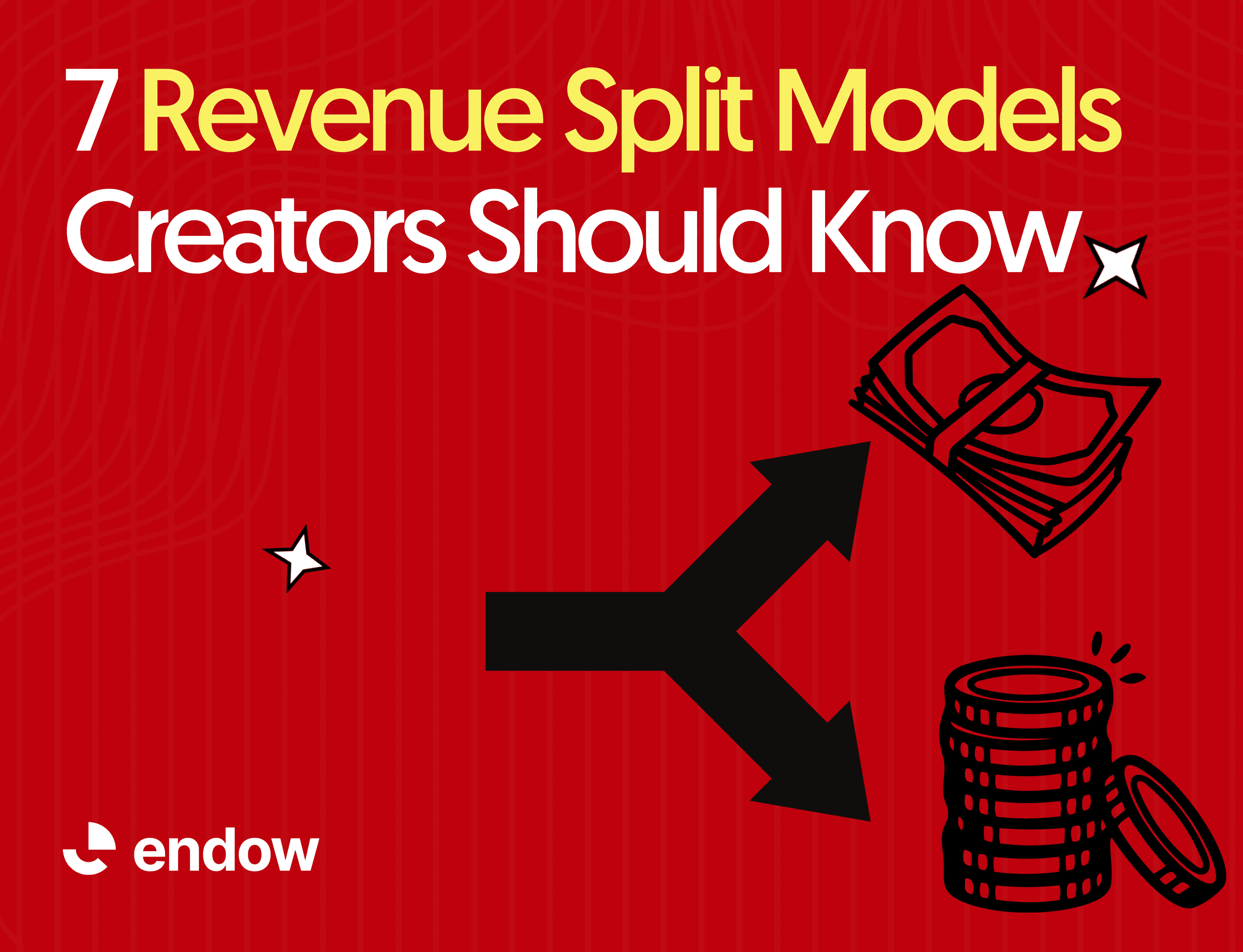
7 Revenue Split Models Creators Should Know
Discover 7 revenue split models creators should know, including equal splits, performance-based payouts, hybrid structures, and ownership models for creator collaborations.
One of the biggest financial mistakes in the creator economy is assuming that collaboration automatically means “50/50.”
It sounds simple.
Fair.
Efficient.
But most creator collaborations are not actually equal.
One creator may bring the audience.
Another handles production.
Someone else manages operations.
Another funds the project.
Yet many creators still default to the same split structure without considering how value is actually being created.
This is where collaboration problems begin.
Not because creators are dishonest.
But because most collaborations are financially undefined.
And when money becomes unclear, relationships become fragile.
That is why understanding revenue split models matters.
Because the structure behind how money is shared determines:
How sustainable the collaboration becomes
Whether contributors feel fairly compensated
How future growth is handled
How conflict is avoided
And whether the project can scale beyond one campaign
Revenue splits are not just payment decisions.
They are operational systems.
This guide breaks down seven of the most important revenue split models creators should understand, when each one works best, and the risks creators should watch for before agreeing to them.
Why Revenue Split Models Matter More Than Creators Think
Most creators focus heavily on content structure.
Very few focus on financial structure.
But the financial structure often determines whether the collaboration survives long-term.
Poor revenue structures create:
Resentment
Delayed payments
Confusion
Unequal workloads
Ownership disputes
Financial uncertainty
Clear split models solve this early.
They create predictability.
And predictability protects collaboration.

1. Equal Split Model (50/50 or Equal Shares)
This is the most common creator revenue split structure.
And also the most misunderstood.
In this model, revenue is divided equally among contributors regardless of role differences.
Example:
Two creators launch a course together.
Revenue is split 50/50.
Or:
Four creators collaborate on a digital product.
Each receives 25%.
Why creators use it
It feels simple.
No difficult negotiations.
No complex calculations.
Fast agreement.
Emotionally, it signals trust and equality.
When it works best
Equal splits work best when:
Contribution is genuinely balanced
Risk exposure is similar
Long-term involvement is equal
Both parties bring comparable value
Where it fails
The biggest issue with equal splits is that contribution often changes over time.
One creator may eventually:
Handle more marketing
Drive more conversions
Manage operations
Take on customer support
But the split stays fixed.
This creates imbalance.
The hidden risk
Equal splits assume equality of effort, risk, and value.
Most collaborations are not actually structured that way.
2. Contribution-Based Split Model
This model allocates revenue according to actual contribution.
Instead of automatic equality, creators define who contributes what.
The split reflects that structure.
Example:
Creator A handles production and audience growth → 60%
Creator B handles editing and distribution → 40%
Why this model is stronger
It aligns compensation with actual work and value creation.
This creates more operational fairness.
Especially in uneven collaborations.
Best use cases
Courses
Podcast networks
Digital product collaborations
Creative agencies
Long-term creator partnerships
What must be clearly defined
Contribution-based systems only work when roles are explicit.
Otherwise disputes emerge later.
Define:
Responsibilities
Time commitments
Revenue responsibilities
Ownership rights
Operational tasks
3. Performance-Based Revenue Splits
In this model, earnings depend on measurable outcomes.
Instead of fixed percentages, revenue allocation changes based on performance.
Examples:
Affiliate conversions
Sales generated
Audience traffic driven
Subscription signups
Lead generation
Example
A creator partnership agreement may state:
Base split → 40/40
Additional 20% allocated based on sales generated
This rewards measurable impact.
Why this model is powerful
It aligns incentives.
Contributors are rewarded for actual outcomes instead of assumed value.
Where it works best
Affiliate campaigns
Launch partnerships
Collaborative digital products
Referral-driven promotions
Influencer marketing campaigns
The challenge
Tracking accuracy becomes critical.
Without proper revenue visibility, performance-based systems become difficult to manage fairly.

4. Fixed Fee + Revenue Share Model
This is one of the healthiest creator collaboration structures.
Particularly for production-heavy projects.
In this model:
A contributor receives:
A guaranteed fixed payment
Plus a percentage of future revenue
Example
A video editor receives:
₦250,000 upfront
Plus 10% of product revenue for six months
Why creators use this
It balances:
Immediate compensation
Long-term upside
This prevents contributors from working entirely on uncertain future earnings.
Best for
Editors
Creative strategists
Course collaborators
Producers
Technical contributors
Creative operations support
The strategic advantage
This structure reduces financial pressure while still rewarding long-term project success.
5. Tiered Revenue Split Model
This model changes percentages as revenue grows.
The split evolves according to milestones.
Example:
First ₦1M revenue → 70/30
Next ₦3M revenue → 60/40
Beyond ₦5M → 50/50
Why this model matters
Early-stage projects often involve uneven risk.
One person may initially carry more operational or financial burden.
Tiered structures recognize that.
Best use cases
Startups
Creator collectives
Subscription businesses
Collaborative product launches
What makes it effective
It allows collaboration structures to mature over time instead of remaining static.
6. Ownership-Based Revenue Splits
This model ties earnings to ownership percentage.
Instead of splitting income based purely on tasks, contributors earn based on equity or asset ownership.
Example:
A creator media business may allocate:
Founder → 70%
Creative partner → 20%
Operational lead → 10%
Revenue distributions follow ownership percentages.
Why this model is important
Not all creator projects are campaigns.
Some become long-term businesses.
Ownership-based structures support long-term scaling.
Best for
Creator startups
Media brands
Newsletter businesses
Creator-led platforms
Long-term intellectual property projects
The key difference
Ownership models focus less on short-term work and more on long-term asset value.
7. Hybrid Revenue Split Model
This is the most sophisticated model.
And increasingly the most realistic.
Hybrid structures combine multiple approaches.
Example:
Base payment
Performance bonus
Ownership allocation
Revenue percentage
Milestone adjustments
All layered together.
Why hybrid models are growing
Creator businesses are becoming more operationally complex.
One-dimensional revenue structures no longer fit modern collaborations.
Hybrid systems allow flexibility.
Example structure
A creator partnership may include:
Fixed upfront payment
Revenue percentage for launch period
Performance bonus after conversion milestones
Reduced long-term percentage after active involvement ends
This creates balance between:
Risk
Contribution
Performance
Longevity

The Biggest Revenue Split Mistakes Creators Make
Understanding the models is important.
But avoiding structural mistakes matters even more.
Mistake 1: Defining percentages but not definitions
Creators often agree on percentages without defining:
Gross vs net revenue
Expense deductions
Platform fees
Taxes
Refund handling
This creates conflict later.
Mistake 2: Ignoring operational labor
Audience size is visible.
Operational work is often invisible.
But invisible work still creates value.
Mistake 3: Treating long-term projects like short-term campaigns
Some collaborations evolve into businesses.
But the original split structure never evolves with them.
This creates imbalance.
Mistake 4: Keeping everything verbal
Verbal agreements feel easier early on.
But ambiguity becomes dangerous once money grows.
Why Revenue Visibility Is the Real Foundation
Most collaboration issues are not actually about percentages.
They are about visibility.
Creators struggle when they cannot clearly track:
Revenue sources
Expenses
Shared payouts
Contribution metrics
Payment timing
Without visibility, even fair agreements become difficult to maintain.
The Shift Creator Businesses Need
The creator economy is becoming more collaborative.
More teams.
More partnerships.
More co-created products.
More shared revenue systems.
This means creators can no longer treat revenue splitting casually.
It needs structure.
Not because collaboration should become corporate.
But because unclear money systems destroy creative relationships faster than almost anything else.
Final Thought
There is no universally perfect revenue split model.
Only the right model for the right structure.
The strongest creator collaborations are not built on vague assumptions.
They are built on:
Clear expectations
Transparent systems
Defined ownership
Trackable revenue
Operational fairness
And the more creator businesses mature, the more important these systems become.
Because sustainable collaboration is not just about creating together.
It is about structuring money clearly enough that everyone can continue growing together long after the first project succeeds.
Managing shared creator income should not depend on spreadsheets, screenshots, or manual calculations.
Use Endow to track revenue, structure collaborations, and manage creator payouts with clarity.
Start building smarter creator revenue systems with Endow
Related Content